Statistical collision sampling
Given are two particle species 1, 2 with their weighting factors , a cell with volume and particle numbers per cell .
The statistical collision treatment estimates the number of collision between particles, which belong to the same cell with cell volume . It is considered, that - within a time step
- two particles with a relative velocity and a total collision cross section put up a collision volume of (see figure below).
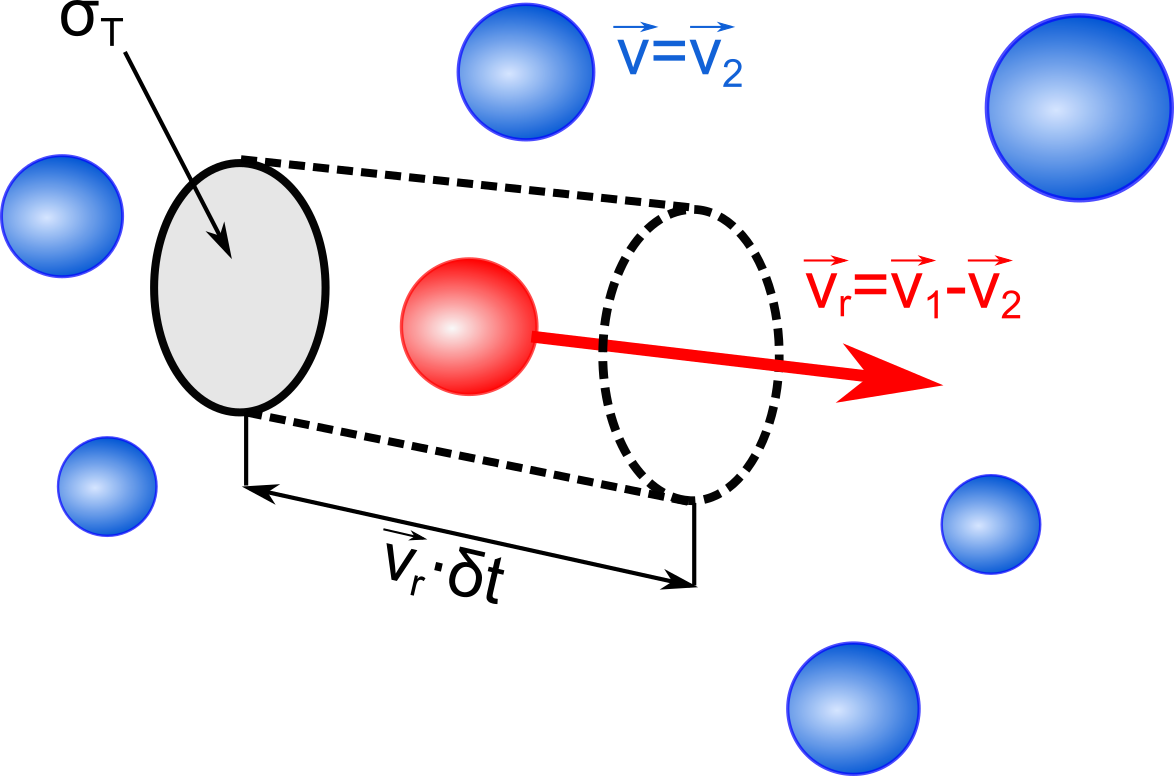
The ratio of this collision volume and the cell volume can be considered as collision probability between two particles within a cell:
In the NTC method, for pre-selection of the maximum reasonable number of collision pairs, the maximum collision probability is obtained from
Collisions between species with same weight factor
In case, both species have the same weight factor the maximum number of physical collisions is
;
however, for the number of selected collision pairs, this number has to be divided by since performing a collision with the stored super particles affects in reality physical particles:
.
As a side note, in case both species are equal and , the number of pre-selected collision pairs has to be divided by factor two (since in case of equal species the order of collision partners does not count):
.
For the number of actually performed collisions, each selected collision pair has to undergo a random experiment, where the following relation is checked (R# is a random number between ]0, 1[):
Thus, the mean number of performed collisions is given as
Collisions between species with different weight factors
In case, are different, let's call the low and high statistical weight factor with . Then, the maximum number of physical collision is
.
In the selected collision pairs the collision shall be actually executed each time for the species with low statistical weight and only times for the other species with the high statistical weight. Under this constraint, the number of selected collision pairs has to be multiplied by to represent the physical number of executed collisions. Therefore, has to be divided by yielding
.
In case, the collision yields reaction products of a third species with statistical weight the number of generated reaction products per executed collision is
Depending on whether is bigger or lower than one, either multiple reaction products must be generated per collision or the generation of a single reaction product is determined by random experiment.
If generation of multiple reaction products per time step shall be avoided, a higher number of collision pairs must be pre-selected:
In this case the number of generated reaction products after collision is one.
Collisions, where one of the collision partners is frozen
In a time-scale splitting scheme, one approach is to consider a certain species distribution as constant, and freeze all particles of this species during simulation. Practical examples are e.g.:
- Freeze the Ar background gas distribution and only consider movement of electrons and ions in electron time scale
- Freeze the charge distribution (electrons + ions) in a reactive plasma and only consider creation of radicals in neutral time scale
Let's denote the weight factor of the frozen species and the weight factor of the moving species in a collision. Then, for the number of pre-selected collision pairs follows
.
The number of reaction product of a third species with weight factor is then obtained via