Substrates
Explanation
All parametrisations either follow 2D Cartesian coordinates () or 2D polar coordinates (), depending on the type of substrate, and transform these into 3D Cartesian coordinates ().
Each of the 2D coordinates is determined from the index of the respective substrate patch, transforming them into the 3D coordinates of the patch vertices. The point at determines the position of the substrate on the trajectory.
The following depictions are always for a sputter-up scenario.
Overview
| Shape | Concave | Python name | Parameters |
|---|---|---|---|
| Disk | no | disk | n_r, n_phi, radius |
| Slanted rectangle | no | slanted_rectangle | n_x, n_y, size_x, size_y, tilt_x, tilt_y |
| Spherical lens | no | spherical_lens | n_r, n_phi, r_curvature, r_base |
| Aspherical lens | no | aspherical_lens | n_r, n_phi, r_curvature, r_base, asph_k, asph_alpha_* |
| Toric lens | no | toric_lens | n_r, n_phi, r_curvature_x, r_curvature_y, height |
| Inverted spherical lens | always | inverted_spherical_lens | n_r, n_phi, r_curvature, r_base |
| Bent rectangle | if height > 0 | bent_rectangle | n_x, n_y, size_x, size_y, height |
| Parabolic lens | if coefficient > 0 | parabolic | radius, coefficient |
Convex substrate types
Slanted rectangle
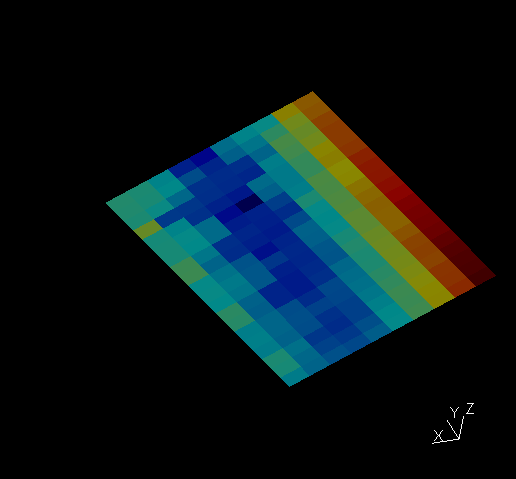
slanted_rectangle
n_x: number of patches in x-directionn_y: number of patches in y-directionsize_x: size of the rectangle in x-directionsize_y: size of the rectangle in y-directiontilt_x: total z-tilt of the rectangle in x-direction, can be 0tilt_y: total z-tilt of the rectangle in y-direction, can be 0
Spherical lens
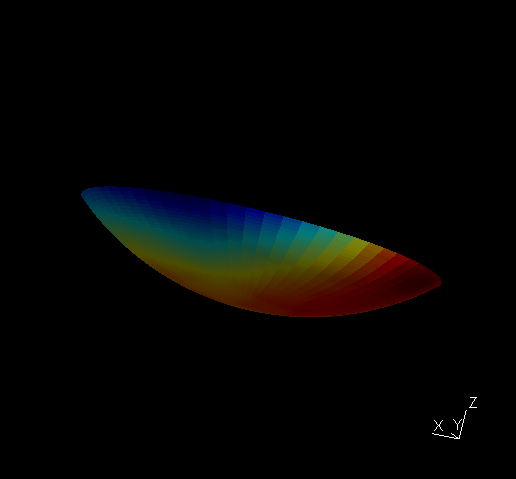
spherical_lens
n_r: number of patches in radial directionn_phi: number of patches in angular directionr_curvature: curvature radius of the lens (if it would be a full sphere)r_base: radius of the lens at its base
Toric lens
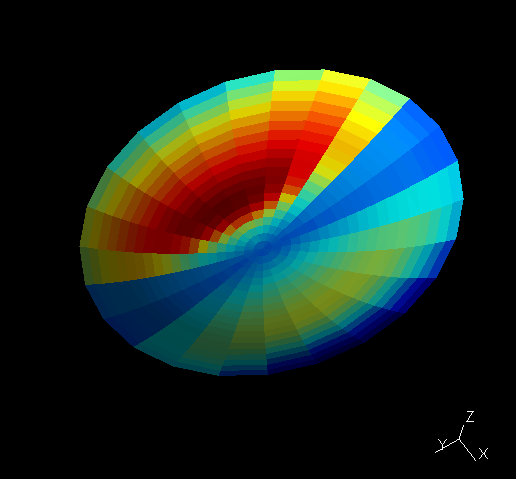
toric_lens
n_r: number of patches in radial directionn_phi: number of patches in angular directionr_curvature_x: curvature radius of the lens in x-direction (if it would be a full torus)r_curvature_y: curvature radius of the lens in y-direction (if it would be a full torus)height: height of the lens (between base and tip)
This parametrisation differs from the others, since the curvature radii are used ordered by their size, defined as and .
Some additional functions used are:
Also, the z position at the base of the lens is used:
Finally, the semiaxes of the elliptic cuts at given radii are (in case of the curvature radius being the larger one):
If on the other hand the x-axis has the larger curvature radius, the roles of x and y have to be switched. Put together we obtain:
Disk
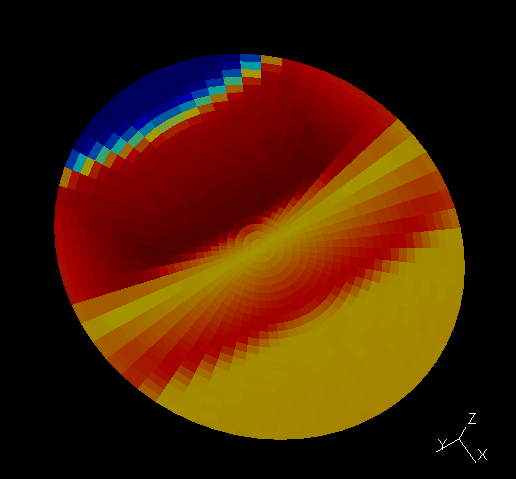
disk
n_r: number of patches in radial directionn_phi: number of patches in angular directionradius: radius of the disk
Aspherical lens
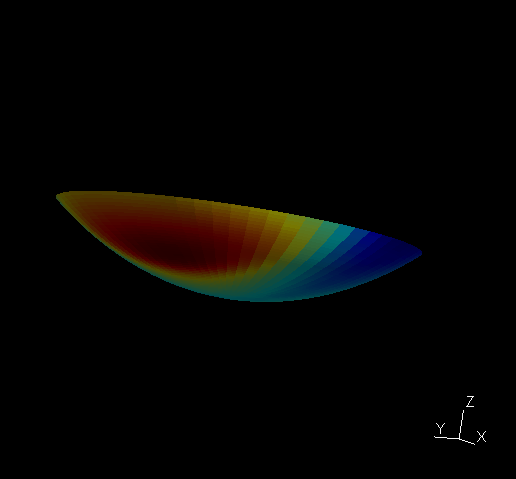
aspherical_lens
n_r: number of patches in radial directionn_phi: number of patches in angular directionr_curvature: curvature radius of the lens (if it would be a full sphere)r_base: radius of the lens at its baseasph_k: conic shape factor
Additionally, aspherical lenses require an arbitrary number of alpha coefficients , named
asph_alpha_4, asph_alpha_6, asph_alpha_8 and so on. The number in the parameter name describes
the exponent of the coefficient (has to be even and at least 4) and its value is the coefficient
itself. Any unspecified coefficient is set to 0 automatically.
The function resulting from the coefficients defines the height of the surface:
Potentially concave substrate types
Inverted spherical lens
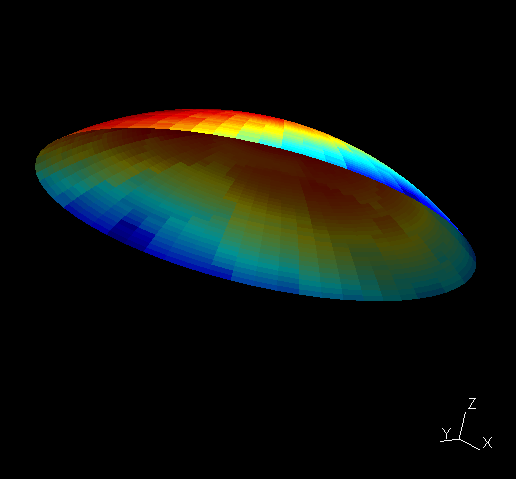
inverted_spherical_lens
n_r: number of patches in radial directionn_phi: number of patches in angular directionr_curvature: curvature radius of the lens (if it would be a full sphere)r_base: radius of the lens at its base
Inverted spherical lenses are always concave.
Bent rectangle
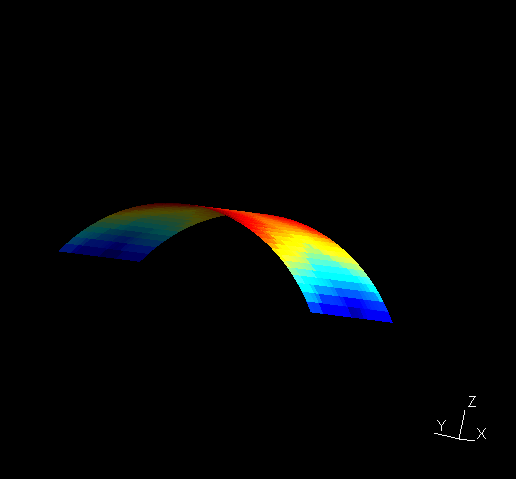
bent_rectangle
n_x: number of patches in x-directionn_y: number of patches in y-directionsize_x: size of the rectangle in x-directionsize_y: size of the rectangle in y-directionheight: height difference between base and tip, can be negative
Bent rectangles are only concave if height is set to a value greater than 0.
The curvature radius of the rectangle is obtained using:
The parametrisation is then:
Parabolic lens
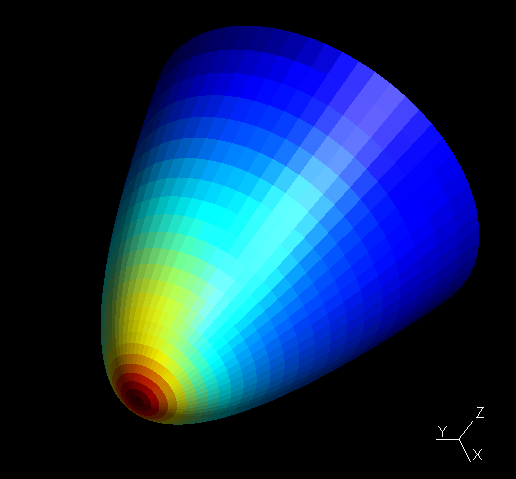
parabolic
radius: radius at the base of the lenscoefficient: coefficient of the parabolic shape function
Parabolic lenses are only concave if coefficient is set to a value greater than 0.
Custom substrates
An entirely custom geometry is defined as a list of triangles:
list_of_triangles = [
  (SRT.PhysVector(0, 0, 0), SRT.PhysVector(-2, -2, 2), SRT.PhysVector(2, -2, 2)),
  (SRT.PhysVector(0, 0, 0), SRT.PhysVector(2, -2, 2), SRT.PhysVector(2, 2, 2))
]

s.generate_geometry_from_mesh_triangles(list_of_triangles, invert_normal = False)
invert_normal flips all triangle normals in case they are not oriented towards the histogram.
Individual normals cannot be flipped, so define the mesh consistently.
Larger meshes in the GMSH .msh format can be loaded through the helper module:
import SRTHelper as SRTHelper

list_of_triangles = SRTHelper.load_mesh_from_file("custom.msh")

s.generate_geometry_from_mesh_triangles(list_of_triangles, invert_normal = False)
The mesh loader needs the Python package gmsh. The coordinate system of the mesh is taken as it is,
so the coordinate origin of the mesh is fixed to the current trajectory point.