PALADIN
PALADIN (PlasmA LAttice Dust INtegrator) follows individual microparticles through a plasma or a gas flow. It is not part of PICMC and it does not compute a plasma by itself: it takes the fields of a plasma or flow calculation that has already been done and uses them to move particles, charge them, let them collide with walls and record where they end up.
The code was written for the question that decides yield in an optical coating line: where do the particles come from that damage the layer, and what would have to change in the machine to keep them away from the substrate.
What it answers
- Where does the contamination come from. A particle track can be followed back to the surface element where it started. Over many particles this turns into a map of sources — target, shields, chamber wall, a flange — instead of a guess.
- Why a particle reaches the substrate at all. The charge a microparticle collects in a plasma moves it, and the plasma is not homogeneous: near the substrate a particle is charged much more strongly than in the bulk and is accelerated towards the part. A trajectory shows that directly, and a change of geometry or pressure shows whether it still does.
- What the contamination looks like. Not one trajectory but statistics: how many particles of which size arrive where, which force dominates along a path, what the size distribution of the adhering particles is.
- What a design change would do. Chamber geometry, gas flow, pressure, target-to-substrate distance, magnetic field: everything that enters the fields or the wall list can be varied in the model before it is varied on the machine.
What it needs
| Input | Shape |
|---|---|
| Geometry | A Gmsh mesh of the volume, with physical groups for every wall, inlet and outlet |
| Plasma or gas fields | Density and temperature per species, electric and magnetic field, gas velocity, pressure, temperature gradient or heat flux — cell-centred .pos files |
| Species properties | Mass density, permittivity, Hamaker constant, size distribution, vapour properties if the particles are droplets |
| Boundary conditions | Wall type and elasticity per physical group, open or periodic bounding box |
| Initial particles | Number, species, and either a surface they are released from or explicit positions and velocities |
The fields normally come from a PICMC run or from a DSMC run of the same geometry. For atmospheric problems — room air, a pump, a ventilated chamber — the gas field comes from a CFD code instead, and only the particle part is done here.
What it delivers
- Trajectories with the full state of each particle per time step: position, velocity, acceleration, radius, charge, mass, kinetic energy, and the individual force contributions.
- Wall statistics: where a particle hit, whether it adhered, how long it had been in contact, and which surface element it started from.
- Fields of particles: dumps in Gmsh
.posformat, so that a snapshot can be opened in ParaView next to the plasma fields that produced it.
Where it sits in the chain
PALADIN is an optional branch, not a stage that every coating problem passes through. The simulation pipeline shows it as a side branch of the plasma stage: the fields of PICMC or DSMC are used unchanged, and what comes out is a statement about contamination rather than about layer thickness.
PICMC  ── plasma fields ──┐
DSMC   ── gas field ──────┼──►  PALADIN  ──►  contamination on the part
CFD    ── flow field ─────┘
Because the fields are read from files, the particle calculation can be repeated with a changed particle species or a changed chamber wall without repeating the plasma stage.
What it does not do
- No plasma solve. Density, potential and temperature are read, not computed. A case without a plasma field is a pure gas-flow problem, and then the charging switches are simply irrelevant.
- No film growth and no optics. What a particle does to a layer once it has landed is a separate question.
- No fluid solver. The gas field has to come from DSMC or CFD.
- Particles are spheres with a radius, not resolved surfaces. What happens on the scale of a roughness or inside a pore is not part of the model.
Examples
The images below are from PALADIN applications at Fraunhofer IST. Each caption names the case; the link goes to the page with the full description.
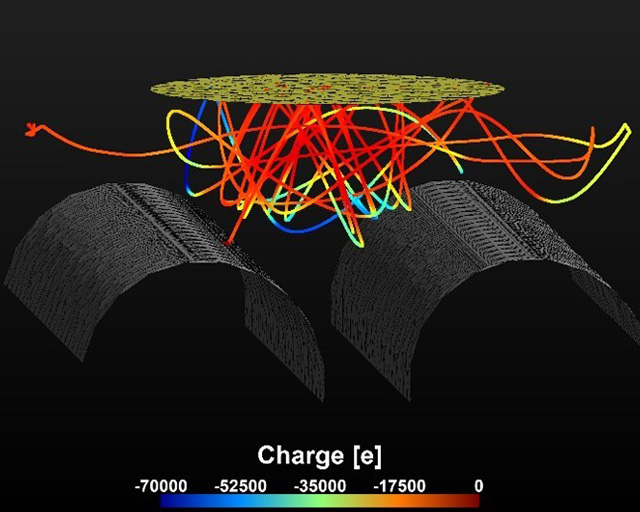
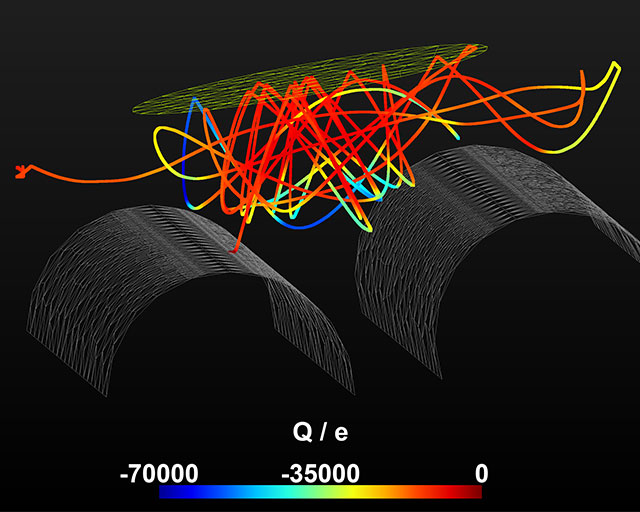
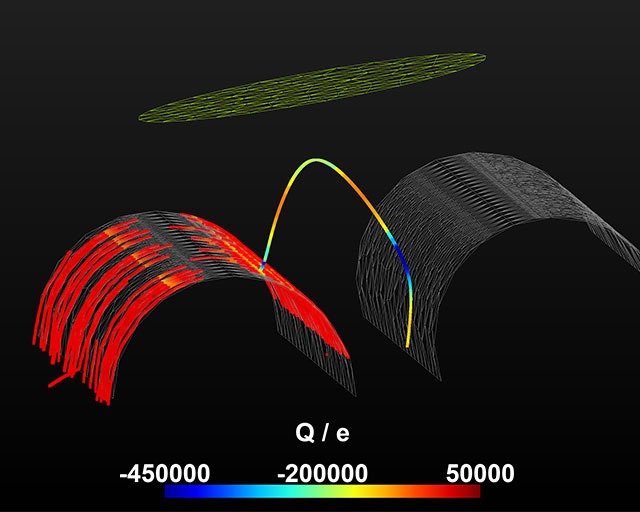
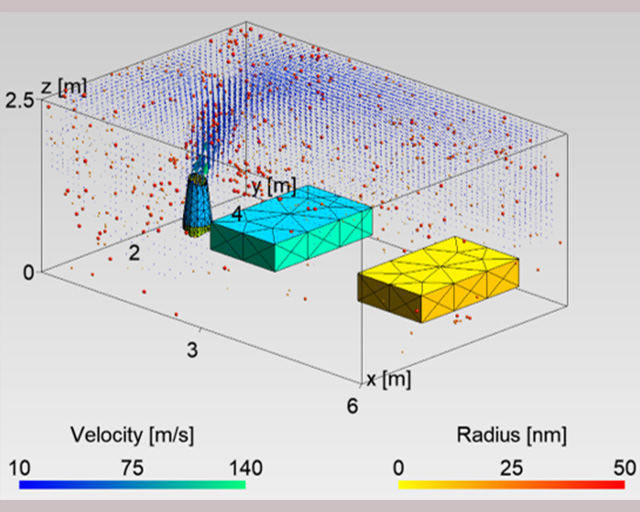
More on these applications:
- Aerosol simulation at Fraunhofer IST — the working group and its projects.
- PALADIN: microparticle simulation — the EOSS® example and the applications outside coating.
- Reducing particle contamination in coating processes — the study behind the charge histories above, including the measured influence of process parameters.
Availability
PALADIN is a separate program from PICMC and is licensed separately by Fraunhofer IST. It is not part of the PICMC delivery, and the source is not distributed with this documentation. For a licence, a feasibility question or a joint project, contact the Simulation and Digital Services group at Fraunhofer IST — Dennis Barton for applications, Philipp Schulz as the author of the code.
If PALADIN is installed at your site, this documentation describes the version that is in the
repository today: the Python-controlled code with MPI parallelisation. Older descriptions that
start a run from a parameter file and a code called submit_emdi refer to a version that is no
longer maintained and do not apply.
Reference
The physical model, the derivation of the forces and currents, and the EOSS® study are documented in:
Schulz, Paul Philipp: Model-based examination of dust particle contamination in plasma coating processes. Dissertation, Technische Universität Braunschweig, 2022. Fraunhofer Verlag, 2023. ISBN 978-3-8396-1886-8. Open access: doi:10.24406/publica-555
In this section
| Page | Content |
|---|---|
| Installation | Build requirements, MPI, build and install, environment variables |
| Building a scenario | The Python scenario: parameters, mesh, borders, fields, species, running a case, output |
| Particle model | What acts on a particle, and which switch turns it on |
| Parameters | Every key of the parameter object, grouped by task |
| Constants and units | Units, physical constants, wall types, distributions, dump quantities |