Electron energy partitioning after ionization
For the electron impact ionization one must decide how to split the remaining collision energy between incident and secondary electron. The most sophisticated numerical expression comes from Opal1 et. al. who did some substantial measurements on this topic. However, using that expression in our PIC-MC code has seemingly no effect at all on any output results. Hence we checked systematically the two extreme case where the secondary electron is uneffected and the remaining collision energy is divided equally between incident and secondary electron, respectively.
Comparision of different partitioning schemes
One takes it all vs. equal share
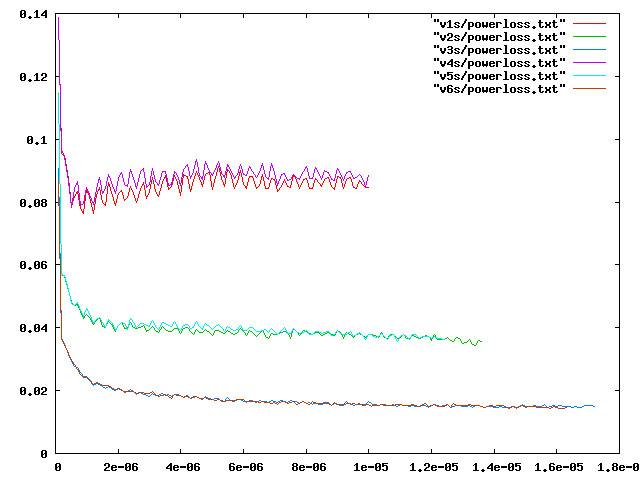
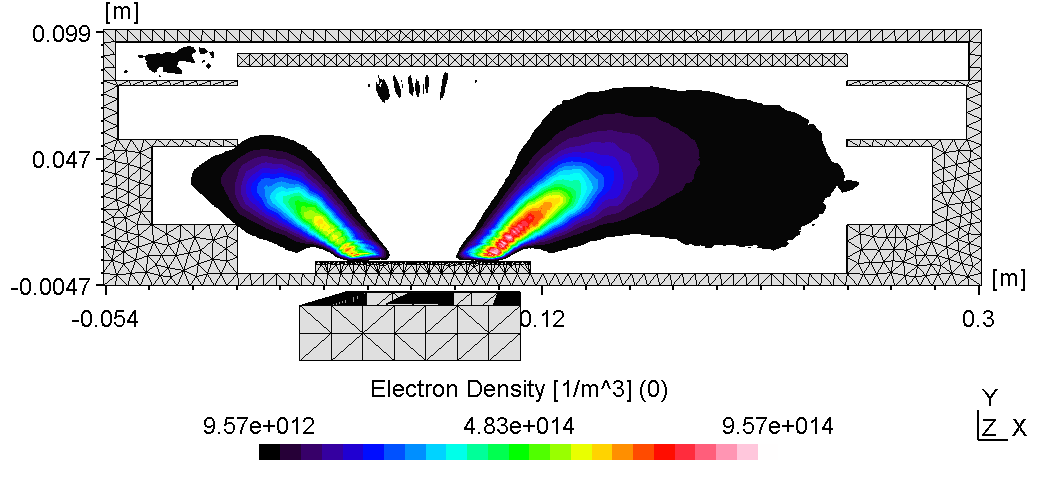
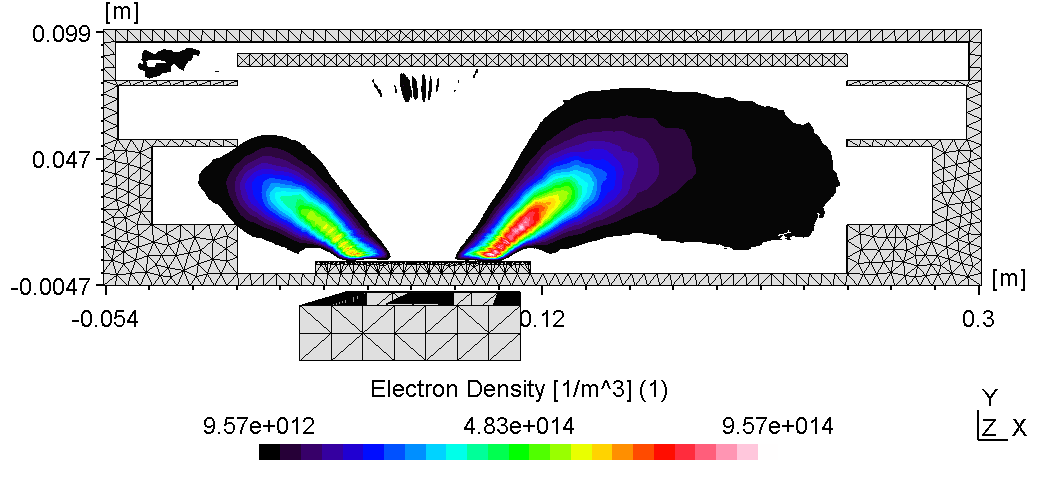
As seen in the simulation results below there is no significant difference between the two extremes. Power dissipation, reaction rates and plasma density are pretty much the same whether we use "one takes it all" or the equal share. Thus, we decided to take the less computational expensive one which is the "one takes it all" scheme. Furthermore this is the one which has been proven sufficiently accurate accordant to the comprehensive studies of Yoshida2 et. al.